Surface Plasmon Resonance Spectroscopy
Surface plasmon resonance (SPR) Spectroscopy is an optical experimental technique that is gaining wide recognition as a valuable tool for surface studies. Under certain conditions, it may offer real-time, in situ, nondestructive analysis of dynamic surface events and thus is capable of determining rates of adsorption and desorption for a range of interfacial processes. The SPR technique is used for in situ adsorption studies of self-assembled monolayers (SAM), polymer adsorption on metal or chemically altered surfaces, and in many biological applications such as protein interactions, lipid bilayers, tissue engineering, cell adhesion on biomaterial surfaces, and antigen–antibody binding.
Free electrons near a metal boundary can, under certain conditions, perform coherent oscillations which are called surface plasmons. These oscillations are electromagnetic surface waves that propagate along the interface between a metal and its dielectric environment. Their frequency ω is related to their wavevector kx by a dispersion relation:
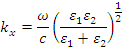
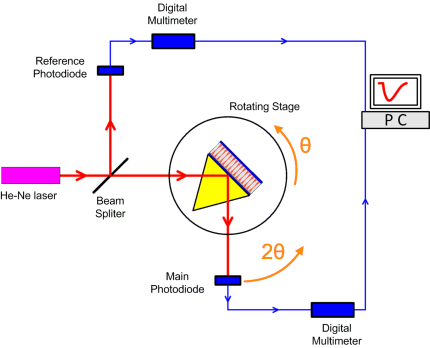
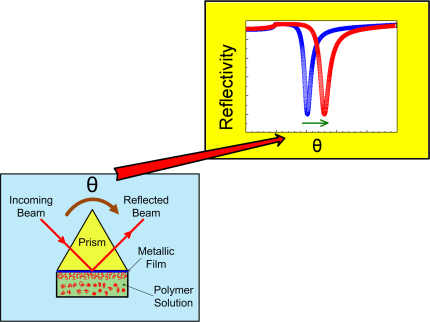
where ε1 is the complex dielectric constant of the metal, ε2 the dielectric constant of the medium that surrounds the metal, and c the speed of light in vacuum. Surface plasmons can be excited by light in the so-called Kretschmann configuration using a metal-coated prism. In this case, the evanescent waves produced by total internal reflection of p-polarized light on the coated face of the prism are coupled with the surface charges and when the projection of their wavevector parallel to the prism face kx fulfils the above dispersion relation, the surfaces charges oscillate collectively with a frequency ω. For a surface plasmon on a thin metal film, the relationship between frequency and wavelength of the wave is not only influenced by the dielectric constant and thickness of the metal film but also depends strongly on the dielectric constants of the materials in the vicinity of the film surface. These facts render SPR spectroscopy a very sensitive tool for surface studies, like the adsorption of molecules on a metal surface. From an experimental point of view, the adjustment of the kx component of the evanescent wavevector is achieved by the rotation of the metal-coated prism at incidence angles above the critical angle for total internal reflection. For a certain incidence angle, kx matches the surface plasmon wavevector and a sharp minimum in the measured reflectivity is observed. The angular variation of the reflectivity is called ‘‘reflectivity curve’’. The experiment concerns to the monitoring of the modifications (shift and broadening) in the reflectivity curve due to the changes in the dielectric environment of the metal if adsorption of molecules takes place in the free surface of the metal film.
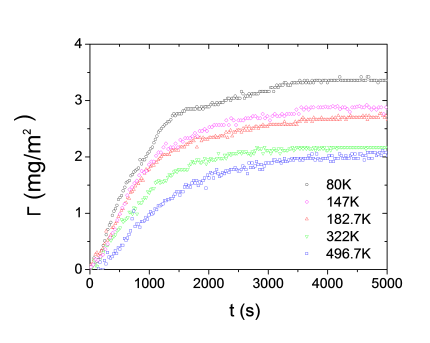
Adsorbed amounts on alumina of five different PS-PEO copolymers as a function of time for 0.01 mg/mL bulk solution concentration in toluene. Each curve refers to the kinetics of a different copolymer that is noted in the inset.